
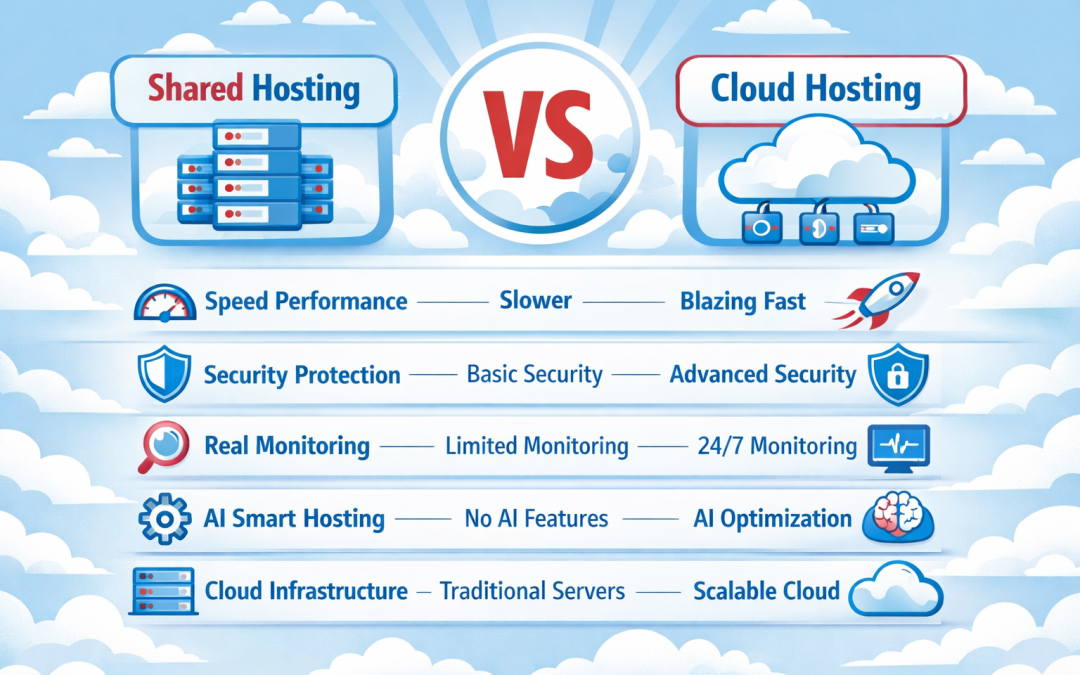
Choosing the right hosting is very important for your website success. Many people feel confused when comparing shared hosting and cloud hosting. This guide will help you understand both in a simple way. You will also see how modern hosting with AI-ready features can solve real problems and improve your website performance.
Shared Hosting vs Cloud Hosting for Beginners
Shared hosting is exactly what it sounds like: Your website shares space with other sites on the same physical server. Resources on that server are accessible to all tenants. While sites themselves are logically separated — meaning they don’t “see” each other on the server — there are a limited number of resources to go around.
Cloud hosting, meanwhile, provides full access to a server in the cloud that is yours alone. You can quickly add or remove sites or services and enable auto scaling options that automatically provide more resources as needed to handle traffic or bandwidth spikes.
This difference is important because your website needs speed, safety, and stability. A smart hosting provider with AI-ready hosting architecture can automatically adjust resources and keep your site running smoothly without stress.
Website Management with Real Monitoring
On the management side of the cloud hosting vs. shared hosting discussion, some similarities exist. For example, both can help you make the most of the available resources with site management consoles that allow you to customize website settings, add new pages and remove old content.
The difference? With shared hosting, management only extends to your digital resources. In the cloud, you get direct access to resources themselves since you’re not sharing servers.
With real monitoring (not just marketing claims), you can track performance issues instantly. This helps you fix problems faster and avoid downtime. Many users prefer hosting that gives real-time alerts and simple dashboards so they stay in control.
Enterprise-Grade Firewall Protection and Built-in DDoS Protection
When it comes to security, cloud hosting typically outpaces shared options. Here’s why: In the case of shared hosting, you depend on the provider’s security practices to ensure your data stays safe. Since you’re one of many tenants on the server, you have limited access to critical security functions.
In the cloud, meanwhile, you have total control over the security of your server. While this doesn’t eliminate the risk of attack, the ability to implement preferred security controls can provide peace of mind.
Modern hosting solutions now include enterprise-grade firewall protection and built-in DDoS protection. These features help block harmful traffic and keep your website safe. This is very important for businesses that handle customer data.
NVMe Performance on All Plans for Faster Website Speed
Performance in a shared hosting environment is governed by two factors: how many tenants share the same server, and the physical components that underpin this server. With many tenants and limited resources, performance can suffer.
Performance in the cloud, however, can be improved with the addition of new resources on demand.
With NVMe performance on all plans, websites load much faster. This improves user experience and SEO rankings. Fast websites keep visitors happy and increase conversions. If your site is slow, you can lose customers quickly.
Scalability with AI-Ready Hosting Architecture and Canadian-Operated Infrastructure
Clouds are naturally scalable. Instead of being limited by the physical hardware of a shared server, cloud hosting allows you to scale up storage, bandwidth and other resources as required. In a shared hosting situation, meanwhile, servers have a fixed resource capacity. While upgrades are possible, they can cause downtime.
AI-ready hosting architecture helps predict traffic spikes and adjust resources automatically. This means your website stays online even during high traffic. With Canadian-operated infrastructure and real human support, you also get reliable service and quick help when needed. This builds trust and ensures your business runs smoothly without technical stress.
Cost Comparison and Smart Hosting Choice for Your Business
Costs in cloud hosting vs. shared hosting environments depend on the type and number of resources you need. In a shared hosting model, you typically pay a fixed amount per month for services. In the cloud, there’s often a base amount you pay per month that may increase or decrease based on usage. This means you must monitor your usage carefully to avoid extra costs. If you want a simple and budget-friendly option, shared hosting works well. But if you want speed, control, and growth, cloud hosting is the better choice.
Choose Hosting That Solves Real Problems
Your hosting choice directly affects your website success. If your site is slow, unsafe, or crashes often, you will lose visitors and sales. Choosing a provider with real monitoring, AI-ready systems, strong security, and human support can make a big difference. When your hosting works smoothly, your business grows faster.