
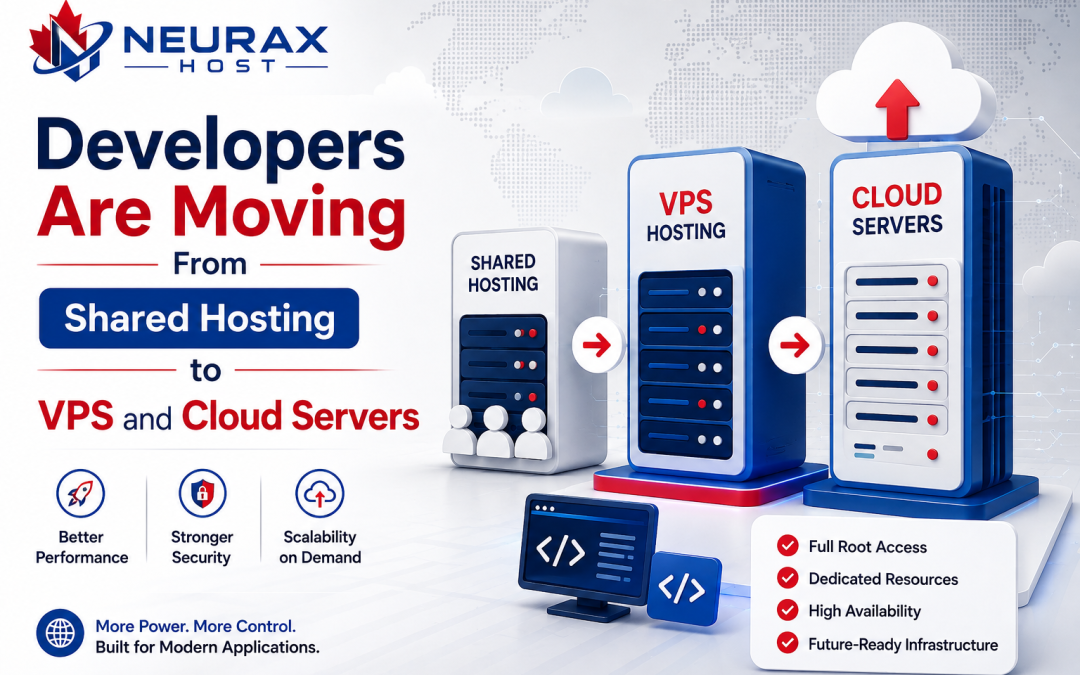
Have you ever visited a website that loaded slowly? Maybe you clicked away before it even opened. This happens a lot on shared hosting. That is why so many developers today are switching to VPS hosting and cloud servers. In this article, we will explain the problem in simple words. We will also show you the facts behind this big shift.
The Problem With Shared Hosting
Shared hosting puts many websites on one computer, called a server. Think of it like an apartment building. Everyone shares the same water and electricity. If one neighbor uses too much, everyone else feels it.
This is called the "noisy neighbor" problem. If one website on the server gets a lot of visitors, every other website slows down too. Your site could crash, even if you did nothing wrong.
Shared hosting is also cheap. Plans often cost just a few dollars a month. That is why beginners like it. But cheap does not always mean good for a busy or growing website. Developers who build real projects need something stronger.
What Is a VPS Server, and Why Is It Different?
VPS stands for Virtual Private Server. A VPS still shares one big computer with other users. But your part of it is walled off. You get your own slice of CPU power, memory, and storage. No one else can use your share, even if their site gets busy.
Think of a VPS like a townhouse instead of an apartment. You still share the building, but you have your own private space, your own rules, and your own utility meter.
Cloud servers go one step further. Instead of living on one physical machine, a cloud server spreads across many machines. If one machine has a problem, another one takes over right away. This makes cloud hosting very reliable for apps that cannot afford to go down.
Developers like VPS and cloud servers because they get "root access." This means they can install any software they need. They can run Node.js, Python, custom databases, or anything their project requires. Shared hosting rarely allows this kind of freedom.
Why Speed and Uptime Matter So Much
Speed is not just nice to have. It changes how well a website works. Nearly half of all visitors expect a page to load in two seconds or less. If your site is slow, people leave, and they may not come back.
Here is where the facts get interesting. Shared hosting often reaches only about 99.5% uptime, which adds up to almost two full days of downtime each year. That may not sound like much, but for a business, that is a lot of lost visitors and lost sales.
VPS and cloud hosting perform much better. Shared hosting usually reaches around 99.7% uptime, while VPS and cloud hosting plans often reach 99.95% or higher. That gap becomes huge over a full year.
Storage speed matters too. Shared hosting on older hard drives can be as slow as 50 MB per second, while VPS hosting with solid-state drives reaches 200 to 500 MB per second. Faster storage means faster page loads, and faster page loads help your search engine ranking too.
Security Reasons Developers Are Switching
On shared hosting, your website lives next to hundreds of strangers' websites. If one of those sites gets hacked, the whole server can be at risk. This is a real danger, not just a scary story.
Studies show that 20 to 30 percent of shared hosting sites remain vulnerable because of software that was never updated. That is a big number, and it shows why developers want more control.
A VPS gives you your own private space. You control your own firewall, your own updates, and your own security tools. Nobody else's mistakes can hurt your site. This is one of the biggest reasons professional developers move away from shared plans once their projects grow.
How to Know When It Is Time to Upgrade
You do not need to switch right away. Small blogs and simple sites often do fine on shared hosting. But watch for these warning signs:
- Your site slows down during busy hours
- You need software the shared host does not allow
- Your traffic is growing every month
- You run an online store or handle private customer data
- Downtime is starting to cost you money or trust
Many hosting experts suggest that once a site passes around 25,000 visitors a month, shared hosting starts to struggle. At that point, a VPS or cloud server gives your site room to grow, without the noisy neighbor problem holding it back.
The Bottom Line
Shared hosting is a fine starting point. It is cheap and easy. But it comes with real limits: slower speeds, shared resources, and bigger security risks. VPS and cloud servers solve these problems. They give developers more speed, more control, and more peace of mind.
If your website is growing, or if you are building something serious, it may be time to leave the crowded apartment building behind. A VPS or cloud server gives your project its own private space to grow strong and stay fast.