
Website speed matters. When a visitor opens your website, every second counts. If pages load slowly, people may leave before reading your content or buying your product. Many website owners try to improve speed by using SSD hosting. However, not all SSDs are the same.
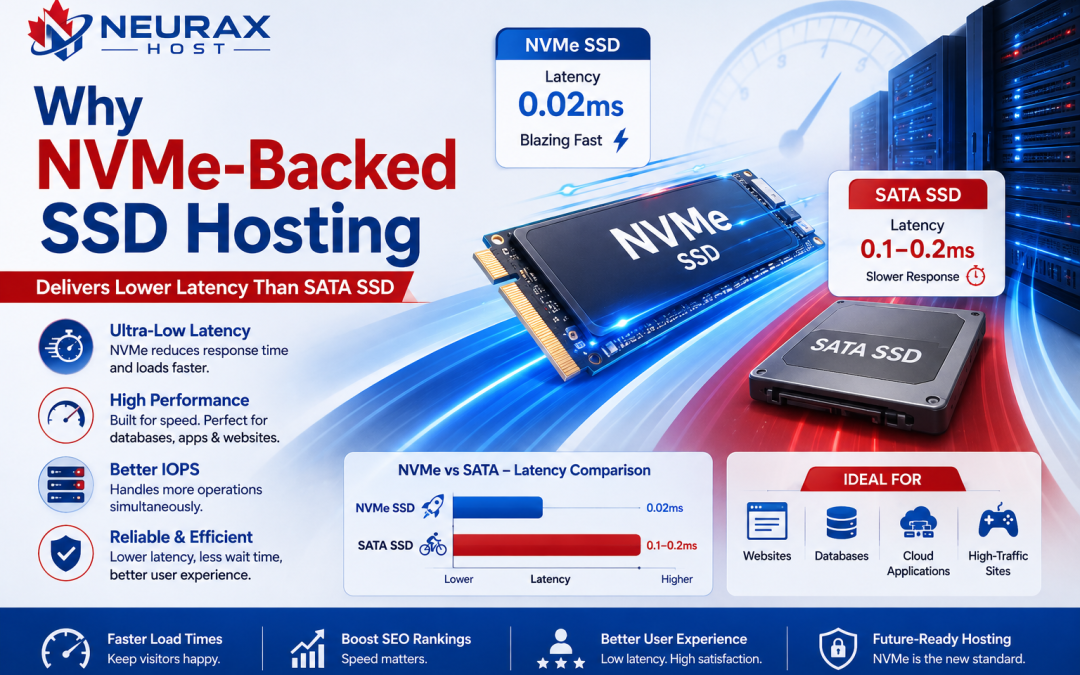
Today, many hosting providers offer NVMe-backed SSD hosting instead of older SATA SSD hosting. The biggest difference is latency, which means the time it takes for data to travel between the server and the storage drive.
In this blog, you will learn why NVMe-backed SSD hosting delivers lower latency than SATA SSD, how it solves real website speed problems, and why it is a better choice for modern websites.
What Is the Difference Between NVMe SSD and SATA SSD Hosting?
A SATA SSD uses the older SATA interface that was originally designed for hard drives. It is much faster than a traditional HDD, but it still has speed limits.
An NVMe SSD uses the PCIe interface, which was designed for high-speed data transfer. Because of this, NVMe can handle many more data requests at the same time.

In simple words:
- SATA SSD = good speed
- NVMe SSD = much faster speed and lower delay
This is why many cloud and enterprise hosting platforms now use NVMe storage.
Why Lower Latency Is Important for Website Hosting
Latency is not the same as bandwidth. A website may have a fast internet connection, but if the storage takes too long to respond, pages can still feel slow.
Common problems caused by higher storage latency include:
- Slow WordPress dashboard
- Delayed page loading
- Slow database queries
- Slower eCommerce checkout
- Delays during traffic spikes
Visitors notice these delays quickly. Studies show that users expect websites to load in only a few seconds. Therefore, reducing latency is very important for user experience.
How NVMe-Backed SSD Hosting Reduces Storage Latency
The main reason NVMe is faster is its connection to the server.
SATA SSDs communicate through a storage controller that adds extra steps. NVMe communicates directly through PCIe lanes, which creates a shorter and more efficient path.
This results in:
- Faster response times
- Lower input/output latency
- Better handling of many small files
- Faster database access
Modern NVMe drives can process many more commands in parallel than SATA drives. This is especially helpful for websites that use thousands of small files, such as WordPress, WooCommerce, Magento, and other dynamic applications.
NVMe Hosting Improves WordPress and Database Performance
Most modern websites are database-driven. Every page may require multiple database queries before it is displayed.
With SATA SSD hosting, these queries are faster than HDD hosting, but they still face interface limitations.
With NVMe-backed SSD hosting:
- Database queries return faster
- PHP processes wait less time
- Cached content is delivered quicker
- Admin actions feel more responsive
For example, when you publish a blog post, update a product, or search orders in WooCommerce, the server performs many storage operations. Lower latency means these tasks complete more quickly.
Why NVMe Performs Better During High Traffic
A common problem is that websites become slow when many visitors arrive at the same time.

SATA SSDs can become a bottleneck under heavy concurrent workloads. NVMe drives are designed to handle a much larger number of simultaneous operations.
This helps during:
- Marketing campaigns
- Viral social media traffic
- Product launches
- Holiday sales
- High-traffic blog posts
The result is more consistent performance and lower response times even when the server is busy.
Real Problem: Slow WooCommerce Checkout
Imagine an online store with 500 products.
With higher storage latency:
- Product pages open slowly
- Cart updates take longer
- Checkout feels delayed
- Customers may abandon the purchase
With NVMe-backed SSD hosting:
- Product data loads faster
- Cart operations respond quicker
- Checkout becomes smoother
- The store can handle more users
This is not just a technical improvement. It can directly affect sales and customer satisfaction.
NVMe Hosting Also Helps Search Engine Performance
Google uses page experience and loading performance as important quality signals. Faster servers can improve metrics such as:
- Time to First Byte (TTFB)
- Server response time
- Core Web Vitals support
- Overall page loading speed

While NVMe alone does not guarantee higher rankings, it helps create a faster website, which supports better user experience and SEO performance.
Is NVMe Hosting Worth the Extra Cost?
Many users ask whether NVMe hosting is worth paying a little more.
For a very small static website, the difference may be modest. However, for most modern websites, the benefits are usually noticeable.
NVMe hosting is especially valuable for:
- WordPress websites
- WooCommerce stores
- Business websites
- Membership sites
- Learning platforms
- High-traffic blogs
- Web applications
Because these sites perform many database and file operations, they benefit the most from lower latency.
Choosing the Right SSD Hosting for Better Performance
NVMe-backed SSD hosting delivers lower latency than SATA SSD because it uses the faster PCIe interface and processes many more storage requests in parallel. This reduces delays between the server and the storage system.
In simple words, NVMe helps solve real problems:
- Faster page loads
- Faster database queries
- Better WordPress performance
- Smoother WooCommerce checkout
- More stable performance during traffic spikes
- Improved server response times
When choosing a hosting plan, look for features such as:
- NVMe-backed SSD storage
- LiteSpeed or high-performance web server
- Sufficient RAM and CPU
- Server-side caching
- Optimized database performance
- Reliable cloud infrastructure
These features work together to create a faster and more responsive website. For businesses that care about speed, user experience, and growth, NVMe-backed SSD hosting is a modern and future-ready choice compared with traditional SATA SSD hosting.