
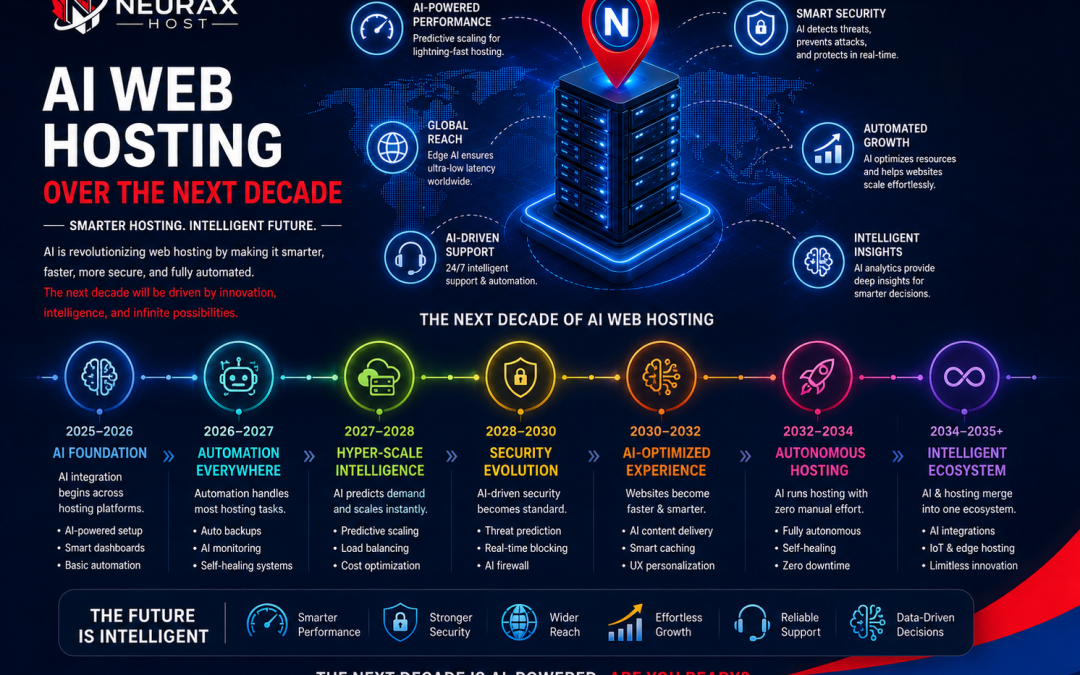
Web hosting is changing as websites become smarter and more demanding. Today, many businesses use AI for chatbots, smart search, content creation, customer support, recommendations, and data analysis. These tools need more than basic server space. They may need more processing power, memory, storage, and fast network connections.
Over the next 10 years, AI Web Hosting is likely to become faster, more flexible, and more automated. But the change will not be only about better technology. Client needs will also change. Customers will expect their hosting provider to offer better performance, stronger security, quick support, flexible resources, and an easy way to manage growing websites. Service providers that understand these needs will be better prepared for the future.
AI Web Hosting Will Need More Powerful Servers
AI-based websites can use more server resources than a normal website. A website may need to process large amounts of data, run AI tools, or handle many users at the same time. Because of this, hosting providers will need to offer better CPUs, more memory, faster storage, and, for some workloads, access to GPUs. These improvements can help websites run AI features without becoming slow.
This also changes what clients will expect from their hosting provider. They will not simply ask, “How much storage do I get?” They may want to know if the hosting can support their AI tools and handle sudden growth. Providers will need to make it easier for clients to increase resources when needed. Instead of moving to a completely new server every time a website grows, clients may expect resources to be added quickly and with less technical work.
Data Centers Will Become More Important
Data centers are the foundation behind modern hosting. They provide the servers, storage, networking, cooling, and security needed to keep websites and applications running. As AI use grows, data centers will have to support higher computing demands. The International Energy Agency estimates that data centers used about 415 TWh of electricity worldwide in 2024, and this could reach around 945 TWh by 2030 in its base case.
For clients, this means the location and quality of a hosting provider's data center can become even more important. A good provider will need reliable power, strong network connections, backup systems, cooling, and security. Clients will also want stable uptime and good website speed for users in different locations.
Over the next decade, hosting providers may also use more data centers closer to users through edge computing. This can help reduce the distance data needs to travel and may improve response times for applications that need quick results.
Clients Will Expect Smarter Security and Support
As websites use more AI and handle more data, security will become a bigger concern. Clients will expect hosting companies to do more than provide an SSL certificate and a basic firewall. They will want regular backups, malware protection, monitoring, access controls, and systems that can identify unusual activity early.
This is where AI can also help the hosting provider. Smart monitoring systems can watch server performance and look for unusual traffic or resource use. They may help providers identify problems before they cause major downtime. A 2026 survey of 446 hosting providers by cPanel found that 53% expected AI-driven automation to have the biggest impact on the hosting industry.
For clients, the benefit is simple: less time dealing with technical problems. In the future, a good hosting provider should not wait for the customer to report every issue. It should monitor the service, find possible problems early, and provide quick help when something goes wrong.
Flexible Hosting Will Become a Bigger Client Need
Website needs can change quickly. A small business may start with a simple website and later add an online store, booking system, customer portal, chatbot, or AI-powered feature. Traffic can also increase during sales, campaigns, or special events.
Because of this, clients will want hosting that can grow with them. They may expect flexible plans where CPU, RAM, storage, and other resources can be increased without a complicated migration. Hosting providers will need to make these changes simple and fast.
Automation will play an important role here. A smart hosting platform could monitor resource use and help providers adjust capacity when demand changes. This does not mean every website will need expensive AI infrastructure. Instead, the goal will be to give each client the right resources for their actual workload and allow those resources to grow when needed.
What Will AI Web Hosting Look Like in 10 Years?
By the mid-2030s, AI Web Hosting could look very different from traditional hosting today. Clients may expect hosting platforms to automatically monitor performance, detect security risks, manage resources, and help keep websites stable. They may also expect faster access to AI-ready servers when their business needs them.
At the same time, energy use will become an important part of the hosting discussion. More computing power means more electricity demand, so providers will need to improve server efficiency, cooling, and power management. The IEA expects renewable energy to meet nearly half of the additional electricity demand from data centers through 2030 in its base case.
The biggest change, however, may be in what clients consider a good hosting service. Price and storage will still matter, but they will no longer be the only factors. Clients will look for performance, security, flexibility, support, reliability, and smart resource management in one service.
A Smarter Hosting Future
The next decade of AI Web Hosting will be about much more than adding AI to servers. It will be about building hosting services that can understand changing workloads and respond to client needs faster. Service providers will need stronger infrastructure, smarter monitoring, better security, flexible resources, reliable data centers, and more efficient systems.
For clients, the goal will be simple: hosting that works well today and can grow with their business tomorrow. Providers that focus on this balance between performance, security, flexibility, support, and efficiency will be in a stronger position as AI becomes a normal part of the web.