
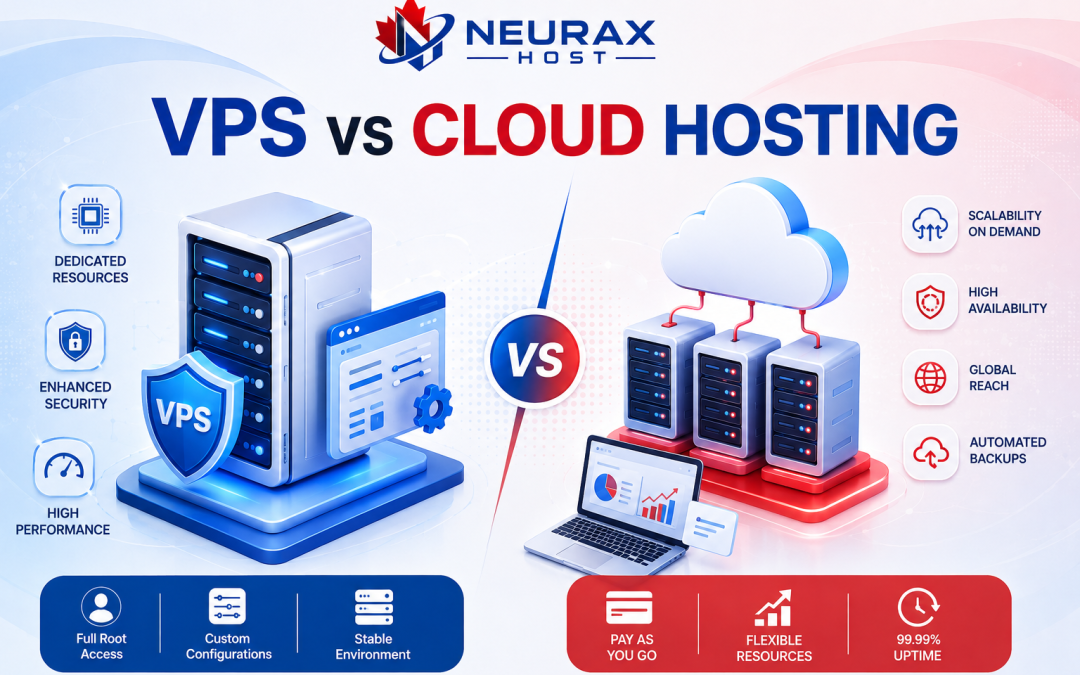
Picking the wrong hosting can slow your website down. It can also cost you money you did not need to spend. Two of the most popular choices today are VPS hosting and cloud hosting. They sound similar, but they work in very different ways. This guide breaks it down in simple words, with real facts, so you can pick the right one for your project.
VPS Hosting vs Cloud Hosting Explained Simply
A VPS, or Virtual Private Server, lives on one physical computer. That computer is split into private sections. You get your own share of CPU, RAM, and storage, and no one else can touch it. Think of it like your own apartment inside a big building. The walls are solid, but you still share the same foundation.
Cloud hosting works differently. Instead of one computer, your website runs across many connected computers at the same time. If one machine has a problem, another one takes over right away. This setup is often compared to a team of workers sharing a job, instead of one person doing everything alone.
Both options give developers more power than basic shared hosting. Both offer root access, meaning you can install the software your project needs. The real differences show up in how each one handles growth, cost, and risk.
The Problem: Why Picking the Wrong One Hurts
Many developers pick a hosting type without thinking about their traffic. This can cause two common problems.
Problem 1: Paying for power you do not use. Cloud hosting often uses pay-as-you-go pricing. If your site has sudden bursts in traffic, this can lead to a bill that changes every month. A store expecting a big holiday sale could see charges jump fast.
Problem 2: Running out of room to grow. A VPS has fixed resources tied to one physical server. If your site grows past that limit, you may need to upgrade to a bigger plan or move to a new server. This can mean extra work and sometimes short downtime.
Knowing these problems ahead of time helps you avoid a painful surprise later.
VPS vs Cloud Hosting: Side-by-Side Comparison
Here is a simple table that shows how the two options compare.
| Feature | VPS Hosting | Cloud Hosting |
| Server setup | One physical server, split into parts | Many servers working together |
| Resources | Fixed CPU, RAM, and storage | Resources can grow or shrink instantly |
| Reliability | Depends on one machine's health | Backup servers take over if one fails |
| Scalability | Manual upgrades needed | Scales automatically, often in seconds |
| Control | Full root access, deep customization | Root access, but more managed tools |
| Best for | Steady, predictable traffic | Sites with sudden or changing traffic |
As the table shows, a VPS gives you steady, predictable power. Cloud hosting gives you flexible power that adjusts to your needs. Neither one is better in every case. It depends on your project.
Pricing: What You Will Actually Pay
Cost is often the biggest factor in this decision. Here is a simple breakdown based on current 2026 hosting data.
| Cost Factor | VPS Hosting | Cloud Hosting |
| Starting price | Around $4 to $5 per month for basic plans | Often similar starting price, but billed hourly |
| Pricing style | Fixed monthly rate | Pay-as-you-go, based on real usage |
| Budgeting | Easy to predict each month | Can be harder to predict during traffic spikes |
| Hidden costs | Fewer extra fees | Possible extra fees for storage, bandwidth, or backups |
| Best for budgets | Small teams who want steady bills | Growing teams who need flexible spending |
VPS hosting tends to win on budgeting simplicity. You know your bill before the month starts. Cloud hosting tends to win on flexibility, but you need to watch your usage closely, or the bill can grow without warning.
Which One Should You Choose in 2026?
There is no single right answer. The best choice depends on your website and your goals.
Choose VPS hosting if:
- Your traffic stays fairly steady from month to month
- You want a fixed, predictable monthly bill
- You need deep control over your server setup
- You are running a blog, portfolio, or business site with normal growth
Choose cloud hosting if:
- Your traffic changes a lot, like during sales or big events
- You cannot afford any downtime, even for a few minutes
- You want your site to grow automatically without manual work
- You are building an app or store that could suddenly go viral
Many growing businesses today use a mix of both. They start on a VPS for its low cost and simple setup. As traffic grows and becomes less predictable, they move toward cloud hosting for its flexibility and built-in backup power. This is often called a hybrid approach, and it lets you get the best of both worlds as your project changes over time.
Whichever path you choose, the most important step is matching your hosting to your real traffic and your real budget, not just picking the option that sounds the most modern.