
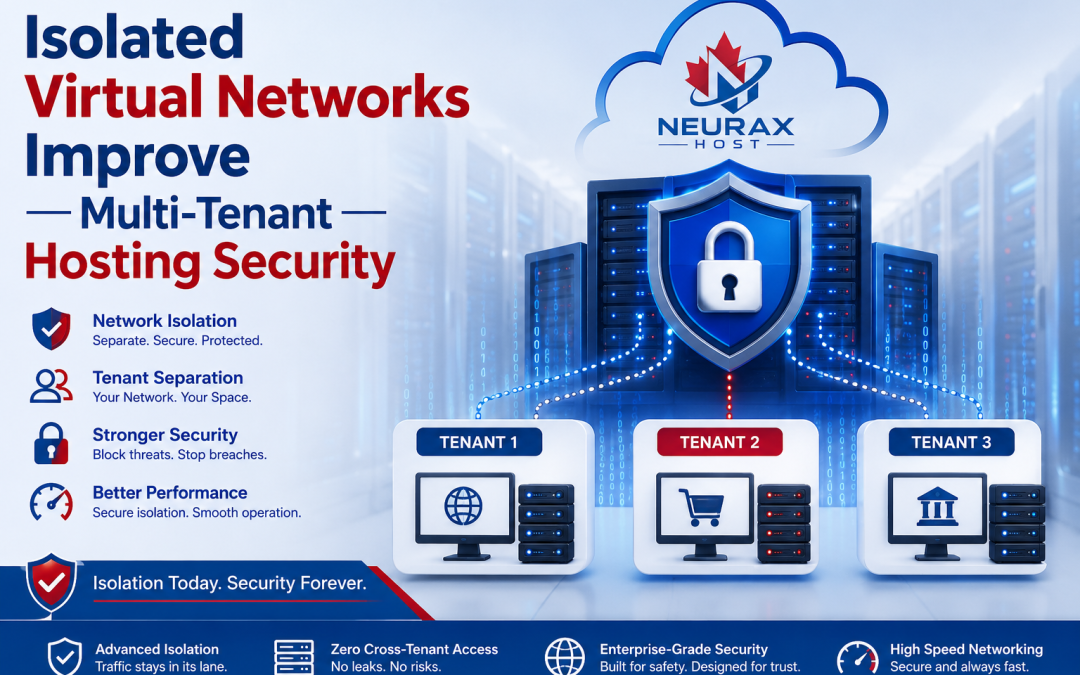
How Isolated Virtual Networks Improve Multi-Tenant Hosting Security
Many websites share the same hosting server. This setup is called multi-tenant hosting. It helps businesses save money and use server resources better. However, many website owners ask an important question: Can another website on the same server affect my website security?
The answer is yes, if the hosting environment is not properly protected.
This is where Isolated Virtual Networks become very important. They create a separate and secure network space for each customer. As a result, websites stay isolated from one another even when they use the same physical server.
In this blog, you will learn how isolated virtual networks improve multi-tenant hosting security, what problems they solve, and why they are now a standard security practice in modern cloud hosting.
Why Multi-Tenant Hosting Needs Better Security
In traditional shared hosting, many users may share the same network environment. If one website is hacked, attackers may try to scan or reach other websites on the same server.
Common risks include:
- Unauthorized network access
- Malware spreading between accounts
- Data exposure
- Traffic interception
- Service disruption
These problems can lead to downtime, loss of trust, and financial damage for businesses.
Therefore, hosting providers need a way to keep customers separated while still using shared infrastructure efficiently.
What Is an Isolated Virtual Network in Hosting?
An Isolated Virtual Network is a private network created for a specific hosting account, virtual machine, or tenant. It works like giving each customer a separate room inside a large building.

Even though all customers use the same physical hardware, their network traffic is separated. One tenant cannot directly communicate with another tenant unless the hosting provider allows it.
This isolation is usually built using technologies such as:
- VLANs (Virtual Local Area Networks)
- VXLANs
- Software-defined networking (SDN)
- Virtual private cloud (VPC) architecture
- Hypervisor-based network isolation
These technologies are widely used by major cloud providers and enterprise hosting platforms.
How Isolated Virtual Networks Stop Cross-Tenant Attacks
A major security problem in shared environments is the cross-tenant attack. This happens when an attacker gains access to one account and then tries to move to another account on the same infrastructure.
With proper network isolation, this movement becomes much harder.

For example, if Website A is infected with malware, the attacker may attempt to scan nearby systems. In an isolated virtual network, those other systems are not directly visible on the network.
As a result:
- Internal scanning is blocked
- Lateral movement is reduced
- Unauthorized connections fail
- Attackers have fewer paths to exploit
This greatly improves the overall security of the hosting environment.
Isolated Virtual Networks Protect Customer Data
Website owners often store sensitive information such as customer records, contact forms, invoices, and login details.
Without proper isolation, network traffic may be exposed to unnecessary risk. Although modern hosting uses encryption, network separation adds another important layer of protection.
An isolated virtual network helps by:
- Keeping tenant traffic separate
- Preventing accidental data exposure
- Reducing the chance of packet sniffing
- Limiting access to internal services
This layered approach follows widely accepted security principles used in enterprise and cloud environments.
Better Firewall Control for Each Hosting Tenant
Another advantage of isolated virtual networks is custom firewall control.
In a shared network, one firewall policy may apply to everyone. However, different websites have different needs.
With isolated networking, hosting providers can apply security rules per tenant.
Examples include:
- Allow only HTTPS traffic
- Block unused ports
- Restrict database access
- Permit access only from specific IP addresses
- Separate public and private services
This reduces the attack surface and helps businesses follow security best practices.
Why Cloud Hosting Uses Network Isolation by Default
Modern cloud hosting platforms are designed around isolation. Virtual machines, containers, and private networks are separated from the start.

This design improves both security and performance.
Cloud providers use isolated virtual networks to:
- Protect customer workloads
- Separate development and production environments
- Secure databases
- Enable private communication between services
- Support compliance requirements
For this reason, businesses moving from traditional shared hosting to cloud hosting often see a significant improvement in security architecture.
Real-World Problem: One Website Gets Hacked
Imagine a server hosting 100 websites.
Without isolation:
- The attacker compromises one website.
- They scan the internal network.
- They find weak services on other accounts.
- More websites become affected.
With isolated virtual networks:
- The compromised website stays in its own network segment.
- Other tenants are not directly reachable.
- Internal scanning is limited.
- The attack is contained more effectively.
This containment is one of the biggest reasons security professionals recommend network isolation in multi-tenant environments.
SEO and Business Benefits of Strong Hosting Security
Security is not only a technical issue. It also affects business growth.
A secure hosting environment can help:
- Reduce website downtime
- Protect customer trust
- Prevent malware warnings
- Avoid blacklisting
- Maintain search engine visibility
Google has stated that website security is important for users, and compromised websites can lose visibility in search results.
Therefore, choosing hosting with isolated virtual networks is both a security decision and a business decision.
Final Thoughts on Multi-Tenant Hosting Security
Isolated Virtual Networks are one of the most effective ways to improve multi-tenant hosting security. They solve a real problem: keeping customers separated even when they share the same physical infrastructure.
In simple words, they help stop attacks from spreading, protect customer data, and give better control over network access.
When choosing a hosting provider, look for features such as:
- Isolated Virtual Networks
- Private networking
- VLAN or VPC support
- Tenant-level firewall rules
- Network segmentation
- Secure cloud architecture
These features are based on proven cloud and enterprise security practices. They do not make a website impossible to hack, but they greatly reduce the risk of cross-tenant compromise and improve overall hosting security.
For businesses that care about uptime, customer trust, and long-term growth, isolated virtual networks are no longer an advanced option. They are an important part of modern secure hosting.